Wednesday, 18 February 2009
09:58 PM
I'm actually supposed to be working on something. This is more fun.
Big Machines Dancing. (video) "Beauty can be found everywhere, even in a pit surrounded by hulking machines." [via Toolmonger via Friend Dennis]
How to Stop Picking Your Nose. Illustrated.
Diagramming the Obama Sentence. For those of y'all who don't follow all the language blogs.
[T]he elegant balance of the central construction shows that Obama has a good memory for where he's been, grammatically, and a strong sense of where he's going. His tripartite analysis of the problem is clearly reflected in the structure of the sentence, and thus in the three main branches of the diagram.
In diagram form:
[via mxrk]
YouTube Comment Fight! (video) "There's gonna be a rumble tonight!" I guess I'll ask again: is there any point in YouTube comments? [via ... don't remember. Prolly Twitter.]
[categories]
roundup, language, writing, general
[tags]
videos, sentence diagrams, backhoe, nose, how-to, obama
|
link
|
Thursday, 12 February 2009
12:35 PM
Birthday boys today, as noted practically everywhere, are Darwin and Lincoln. If you've got some spare time today, read Lincoln's Second Inaugural Address ("With malice toward none, with charity for all, with firmness in the right as God gives us to see the right, let us strive on to finish the work we are in ...").
Bible Illuminated. The New Testament meets National Geographic. Interesting idea. [via Jeff Atwood, who referred to it as "Bible 2.0"]
The Wired.Com Tech Layoff Tracker.[1] Watch the job market in the tech industry tank, bleah. Links included to other, similar (similarly depressing) tracking sites. Speaking of things economic ...
You Try to Live on 500K in This Town. The Fashion & Style section in the New York Times explains the hardship of a $500K cap on executive salaries. I imagine that the sympathy level for this situation is floating at around 0 percent. Golly, they'd have to pull their kids out of private school. Of course, many people can just kiss off higher education for their kids altogether, can't they? As but one thought.
Darwin The Dog Lover. The writer claims that Darwin's scientific skills (implication: leading to the theory of evolution) were sharpened by his interaction with dogs. Sure, what the heck, I'll buy that.
[categories]
roundup, books, general
[tags]
bible, tech industry, salaries, dogs, Darwin
|
link
|
Friday, 6 February 2009
01:53 PM
Kinda went to town on the pix and quotes today, oh well.
Pizza-Pro 3000tm. No comment.
[v Friend Dennis]
And speaking of tools ...
The Ultimate Dogfooding Story. In the world of software, "dogfooding" refers to testing software by using it yourself. ("Eat your own dogfood.") Jeff links to a post by Erik that references a thingy named Sawstop, which is a safety device for table saws. Here's Erik:Slide a piece of wood into the spinning blade, and it cuts the board just like it should. Slide a hot dog into the spinning blade, and it stops instantly, leaving the frankfurter with nothing more than a nick. The interesting part of the story (read Erik's piece) is how this guy tested the device.
Fastidious spelling snobs pushed over the edge. People who get wigged out by spelling errors might be suffering additional stress, given current economic ills.[1] [via Fritinancy]
Lexicon. Facebook has a neat little app that "counts occurrences of words and phrases on Walls over time." (Must have a Facebook account to use, of course.) Here are a few of examples that I found interesting (click to see larger images):
Search term: "Obama" (note spike, which is in November): 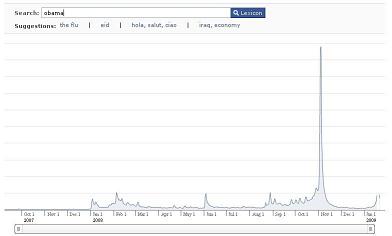 Search term: "Mike" (note extremely even distribution -- hey, it's a popular name!) 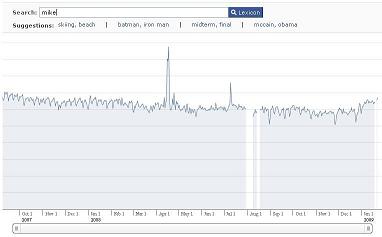 Search term: "Mariners" (note that the range is essentially baseball season. The uber-observant might note that the graph falls off before the World Series, haha.) 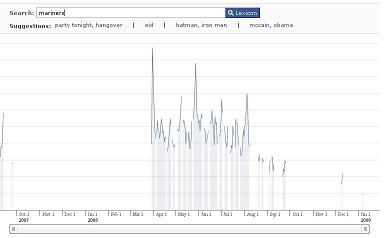
[categories]
roundup, language, technology
[tags]
tools, pizza cutter, dogfooding, Facebook, spelling, punctuation
|
link
|
Wednesday, 28 January 2009
11:20 AM
You know what I wouldn't mind? A bit of sunshine. Wrong time (winter) in the wrong place (Seattle), I guess.
Fake reviews prompt Belkin apology. I guess I've just always assumed that some number of product reviews (and restaurant reviews) are by shills. (I'm usually most suspicious of the ones with the really, really bad grammar, haha.)
The #1 Song on this Date in History. What was the #1 song on the Billboard chart on the day that you were born? (Me, it was Elvis Presley, "Too Much.") [via Sarah] [18 Feb 2012: h/t to Rupert Charles for the updated link!]
What the Web knows about you. Check out the list in the sidebar of all the things the author was able to find about himself. [via ... just about everyone]
Facebook and list mania, aka "25 Things About Editors". John McIntyre's editor-specific take on the "25 things about me" meme that's been going around.
[categories]
roundup, technology, history, music, editing
[tags]
product reviews, Billboard, privacy, Facebook
|
link
|
Monday, 12 January 2009
02:55 PM
Today we concentrate on people's opinions, I guess. Except for that teeth thing.
Grammar Girl's Strunk & Twite: An Unofficial Twitter Style Guide. Grammar Girl posts thoughts (more like commandments) on how to write tweets. [via Fritinancy]
Chew on this: We'll soon be able to grow replacement teeth. "Now comes tooth regeneration: growing teeth in adults, on demand, to replace missing ones. Soon." Finally, a good use for wisdom teeth.
The Secret saved my life! If you've ever wondered about all the hype around the book/CD/DVD The Secret and its claim to be able to improve your life just through the power of thinking, you might find this book review quite inspiring! [via (again) Fritinancy]
And speaking of Amazon reviews, have a look at the customer reviews for the Playmobil Security Check Point.
[via Friend Megan]
How to Give Directions. I take a professional interest in how people write up recipes and in how they give directions. Both can be harder than they appear. This, another entry in the eHow wiki, is excellent advice for the second of these challenges.
[categories]
roundup, writing, technology, funny
[tags]
twitter, teeth, The Secret, Playmobil, directions
|
link
|
Tuesday, 6 January 2009
07:02 PM
What kind of person uses a computer to generate their cover letter? At night?
4 Types of Person (a guide to stupidity) Odds are that you're not a Mr. Spock.
The Sky in Motion. Beautiful time-lapse movies of the night sky. [via Friend Steve]
Resolution Randomizer. Let the computer make your resolutions. The text is ok, but the graphics are great. (Requires Silverlight.) [via Brad Abrams]
Cover Letters from Hell. Killian & Company posts excerpts from some of the worst cover letters they've gotten. They observe: "An error-free letter is now so freakin' rare that the minimal care required to send a letter with zero defects, combined with a few crisply written simple declarative sentences, will, alone, guarantee a respectful reading of a résumé." [via Fritinancy]
[categories]
writing, editing, roundup, general
[tags]
astronomy, cover letters, new year resolutions
|
link
|
Tuesday, 30 December 2008
02:31 PM
If it's the end of the year, it must be time for end-of-the-year stuff.
The Seven Best Capers of 2008. A roundup (hey, wait ...) of criminal activity this year that showed unusual imagination. With the qualifier that the best capers of all are those that are never detected ...
Motorcycles Finally Go Green. "Motorcycles may deliver 70 mpg or more, but they can be 10 times more polluting per mile than passenger cars." And that's street bikes; traditional two-stroke engines -- still popular on dirt bikes for their power/weight ratios -- are incredibly dirty. (Advanced designs for two-stroke engines ameliorate this considerably.)
The Fargo campus responds to Redmond's December 2008 storm conditions. During our recent snow episode here in the Seattle area, the Microsoft campus was effectively shut down due to, you know, snow and cold. The folks at Microsoft's Fargo (North Dakota) campus were not impressed, and issued their own Real Estate and Facilities announcement.[1]
Saying it wrong on purpose. An article on wordplay via mispronouncinations (<-- haha). Much of the fun is contributed in the comments. (I particularly like refrigulation machine for the fridge.) [via wishydig]
[categories]
roundup, technology, language
[tags]
capers, lists, crimes, motorcycles, words, pronunciation
|
link
|
Tuesday, 9 December 2008
12:02 PM
Sort of a holiday-catalog theme going on here.
A behemoth of a knife! The ultimate Swiss Army knife. They claim it's the complete list, but it does not appear to have, for example, a USB flash drive. That might be a different Swiss Army knife company, tho.
Dogs Understand Fairness, Get Jealous, Study Finds. They even get petulant: "The unrewarded dogs eventually stopped cooperating."
Bad Moon Rising. "Do you suffer from the heartache of Plumber's Butt?" DuluthTradingCompany.com has the solution for you.[1]
[via Friend Dennis]
Fortune this! What if Italian restaurants gave out fortune cookies? (Read the comments.) Sample: "Teach a man to fish and you feed him for a day. Send him to sleep with the fishes and he never needs to be fed again." [via Fritinancy]
[categories]
roundup, technology, funny
[tags]
swiss army knife, plumber's butt, t-shirts, dogs, jealousy, fortune cookie
|
link
|
Wednesday, 26 November 2008
01:33 PM
Getting toward gift-giving season. Let the crass ads begin ...
Jackson Pollock by Miltos Manetas, aka make your own Pollock. Just move the mouse around and click. [via Daughter Sabrina]
Microsoft's SideSight: Something Apple Should Watch. Taking the touch screen virtual, for (e.g.) devices that don't have enough actual screen space.
Hamlet (Facebook News Feed Edition). Sample: "Hamlet and the queen are no longer friends." The original is on McSweeney's; Angela Liao has created an image of what the Facebook page would look like:
[via Son Zack]
My First Rifle. Crickett .22 rifles. Perhaps your young one wants the Model 221 in pink.[1] It's probably a pretty good idea for the company to add the tag line "Not a toy." (This ain't no Red Ryder carbine-action range model air rifle, kid[2].)
[via Colleague David]
[categories]
roundup, general, funny, technology
[tags]
jackson pollock, art, painting, rifle, .22, hamlet, facebook, shakespeare, NRA, Jean Shepherd
|
link
|
Thursday, 20 November 2008
01:35 PM
It's the Thursday-technology-and-politics edition. I guess.
Etch-a-sketch clock. Robotically controlled Etch-a-sketch draws the time (once per minute).
[via grow-a-brain]
Challenged ballots: You be the judge. Examine pictures of disputed ballots in the MN congressional race (primarily between Al Franken and Norm Coleman) and render your opinion on how the ballot should be counted.
[via Colleague Molly]
Wii Theremin. From Make magazine: "Ken Moore, a user experience designer at Google, created a very convincing Theremin simulator using a Wiimote and a Roland JV-1080 synth." There are videos, including one of Moore playing the Star Trek theme, which seems appropriate, nu?
[via Laurel at O'Reilly]
[categories]
roundup, technology, politics
[tags]
robots, etch-a-sketch, clock, theremin, wii, ballots, voting
|
link
|