About

I'm Mike Pope. I live in Seattle. I was a technical writer and editor for over 40 years, now retired. I'm interested in language, software, writing, editing, music, movies, books, travel, cats.

Read more ...

Blog Search


(Supports AND)

Feed

Subscribe to the RSS feed for this blog.

See this post for info on full versus truncated feeds.

Quote

One of the things that draws writers to writing is that they can get things right that they got wrong in real life by writing about them.

— Tobias Wolff


Navigation


<July 2026>
SMTWTFS
2829301234
567891011
12131415161718
19202122232425
2627282930311
2345678

Categories

  RSS  
  RSS  
  RSS  
  RSS  
  RSS  
  RSS  
  RSS  
  RSS  
  RSS  
  RSS  
  RSS  
  RSS  
  RSS  
  RSS  
  RSS  
  RSS  
  RSS  
  RSS  
  RSS  
  RSS  
  RSS  
  RSS  
  RSS  
  RSS  
  RSS  
  RSS  
  RSS  
  RSS  
  RSS  
  RSS  
  RSS  

Contact Me

Email me

Blog Statistics

Dates
First entry - 6/27/2003
Most recent entry - 6/27/2026

Totals
Posts - 2685
Comments - 2702
Hits - 2,830,475

Averages
Entries/day - 0.32
Comments/entry - 1.01
Hits/day - 336

Updated every 30 minutes. Last: 11:14 PM Pacific


  08:33 PM

Some folks these days write up year-end pieces on 52 things they've learned in the preceding months — Tom Whitwell was the first one I encountered, and Nancy Friedman has written roundups as well. This year I managed my own! A 52-item list of things I learned is offered here for your inspection and possible amusement/enjoyment.

  1. The Wikipedia article about the Ship of Theseus has been edited so many times that not a single original sentence remains. I've seen this claim several times, but I don't know how you'd verify it. From a Reddit thread.

  2. The word squeegee is older than I thought. If you'd asked me, I would have guessed that it was a genericized trademark. But no; it's probably a nautical term from as early as the 1840s that might have referred to a mop or mopping. From Etymonline.

  3. In the US, pickup trucks have gotten much bigger, and the cabin size has gotten much bigger in proportion to bed (cargo) size. This is best illustrated by a couple of charts. Here's a size comparison over time from Business Insider:

    And here's the change in the proportion of cab to bed from the Diminished Value of Georgia site:

    More on the evolution of pickup trucks, including why they're so popular now, in Axios.

  4. Once a seed "decides" to germinate, it's on a tight timeline. "The baby plant root has forty-eight hours after it decides to emerge to locate water and nutrients, and then push out a leaf or two and begin photosynthesizing, before it runs out of resources and dies." From the book The Light Eaters.

  5. Do you have a zither? It's probably either 60 or 110 years old. Because the instrument has experienced a couple of revivals, "… it has become something of a truism that most zithers seen today are either 60 or 110 years old." From Wikipedia.

  6. The Seattle suburb named White Center was almost named Green Center. "In 1918 [developers] George White and Hiram Green good naturedly resolved the question of what to call the booming community. White won a coin toss with Green, and thereafter the community was called White Center." The area is also informally known as Rat City (hence the team name Rat City Roller Derby). From HistoryLink.org.

  7. Fire once helped preserve library contents that were written in cuneiform. Usually, of course, a library fire is a disaster. However, when the library at Nineveh burned 612 BCE, the fire hardened the clay on which scribes had written in cuneiform. Because of this, we know a lot about everyday life in Neo-Assyria. From the 99 Percent Invisible site.

  8. How much energy does AI really take? Not as much as other common activities. One claim: "So if you’re skipping a simple GPT query thinking you are 'saving the environment,' understand that you’re making a choice equivalent to not eating ~1/17,000th of one burger. The environmental impact of consumer AI use pales in comparison to transportation and is utterly dwarfed by beef consumption alone". From a thread on Threads.

  9. Zildjian [the cymbal company] is the oldest manufacturer of musical instruments in the world. It's also one of the oldest continuously operating companies in the world; it's been in business since 1618. From Wikipedia.

  10. The Smart Cow problem sounds like a joke but it's serious. The Smart Cow problem "… is the concept that when a group is faced with a problem, only one person has to figure it out and the rest will learn it by watching him". This problem has implications for things like computer security: it takes only one person to crack a cypher that is then cracked for everyone. Why a cow? Because when one cow figures out how to cross a barrier, the other cows will follow. From Reddit.

  11. Icelandic speakers would rather create an Icelandic word than borrow one. "We have a very good old word for that." When Icelanders need a term for something, they like to reach back into their language rather than borrowing a word. From the Subtitle podcast.

  12. How "I'm not a robot" checks work. At one point, AI was much better at solving old-style CAPTCHA tests — the mangled letters — than humans were. Now we have "I'm not a robot" checkboxes that can detect robots. "The click isn't the test. The test comes before the click." Fun video via Reddit.

  13. Can brands of salt differ in how salty they are? Yes. The salt crystals in different brands of salt aren't just different sizes; they have different shapes as well, which is why one brand can seem saltier than another for the same quantity of salt. From America's Test Kitchen.

  14. A few case inflections from Old English are still hiding out (albeit fossilized) in modern English. Examples include alive (OE on life with a dative singular ending); olden (ealdum, dative plural); the more the merrier (þy/þy, instrumental). From Reddit.

  15. Why libraries can't lend out an infinite number of ebooks. "You'd think a digital product would have an infinite lifespan, but no. Publishers often set an expiration date or limit the number of borrows an ebook can go through before it has to be purchased again." From a thread on Threads.

  16. People have been braiding their hair for as long as 30,000 years. From Wikipedia.

  17. The word ambisinister means "awkward with both hands". It's the opposite of ambidextrous. The Latin root sinistr means "left" and metaphorically "inauspicious"; the root dexter means "right" and metaphorically "skillful". I'm not sure how widely accepted ambisinister is, but it's listed in some dictionaries, e.g. Dictionary.com.

  18. What "QR" in QR code stands for. Give yourself a second to think about this. Me, I had no idea. Answer: it stands for "quick response". From a fun history of QR codes on the GovTech Singapore site.

  19. The printing press might have ruined English spelling. "If only the first printing presses had been delayed by a generation, English spelling would likely look completely different — and a lot more sensible." From Colin Gorrie's Substack.

  20. OnlyFans makes incredible amounts of money. "In 2023, OnlyFans creators received a stunning $5.3B in payouts (more than the total NBA salaries of $4.9B for 2023-24 season)". From Trung Phan's Substack.

  21. The most frequent injury in the US military is hearing loss. "Hearing problems are by far the most prevalent service-connected disability among American veterans." This has led the military to start adding suppressors ("silencers") to rifles. From the US Defense Department.

  22. The weird little flap in cat ears is called Henry's pocket. More formally known as the cutaneous marginal pouch. The function of the pouch isn't clear, but "common conjecture regarding the usefulness of the Henry’s Pocket is that it helps aid a cat in detecting higher pitched sounds by acting as a muffler to lower pitched sounds." Who was Henry? Not known. From the Rover.com site.

  23. Gas-electric hybrid vehicles have been around since the 1890s. Maybe not surprisingly, a pioneer in this design was Ferdinand Porsche. From Wikipedia.

  24. Official multilingualism is the norm. "More than 80% of the world’s countries are officially bi- or multilingual." From the Linguistic Society of America.

  25. English has a lot more vowels than many other languages. "In the sample of languages surveyed for this chapter, the average number of vowels in a language is just fractionally below 6". English has 13 or so (depending on how you count). German has even more. From The World Atlas of Language Structures Online.

  26. The Mona Lisa (painting) didn't become famous-slash-iconic until it was stolen in 1911. More specifically, the painting was known but hadn't reached a wide audience, and it wasn't iconic the way it is now. There's a quick history on Reddit.

  27. The three dots (or other glyph) that separate subsections or scenes in a text are called a dinkus. From a thread on Threads.

  28. The number of threads of corn silk in an ear of corn is the same as the number of kernels. File this one under "makes sense once someone tells you". From Serious Eats.

  29. Among famous bands are several "two-hit wonders". We all know about one-hit wonders, but it turns out that there are some well-known artists that are technically two-hit wonders (having top-30 songs), including Pink Floyd, Phil Collins, Jimmy Buffet, and The Clash. Fun (sad) fact: Creedence Clearwater Revival never had a #1 hit. From the Can't Get Much Higher Substack.

  30. There's a shortage of carpenters in the US. "Builders have more trouble finding carpenters than roofers, electricians, or just about anything else, and by a wide margin." Part of the problem is that carpentry doesn't pay as well as other trades. From The Hustle.

  31. You don't just go to the Hermès store and buy a Birkin bag. Customers "have to purchase a number of ancillary items and build relationships with a sales associate to get the opportunity to buy a bag". High-end fashion is a mystery to me in many ways. From the SatPost Substack.

  32. Picking your nose might increase your chances of developing Alzheimer's and dementia. "The authors suggest that nose-picking damages the nasal mucosa, making it easier for the bacteria to reach the olfactory nerve and enter the brain." From Medical News Today.

  33. Where do babies come from? People have disagreed. The notion that babies come from the union of an egg and a sperm (congenerism) has not been a universal understanding, and a variety of sometimes interesting theories have had influence over time. Sometimes it's been because congenerism was politically inconvenient or (probably more often) just plain uncomfortable. "According to al-Saghir, he himself had been conceived when his parents played a particularly hard-fought game of chess." From Asterisk.

  34. Tuberculosis was once strongly associated with creative genius. In fact, "when TB rates declined in the U.S. toward the end of the nineteenth century, some physicians worried it would harm the quality of American literature." This and many other amazing facts about TB (like, TB has killed more people than any other disease in history) from the book Everything is Tuberculosis.

  35. The second-most spoken language on the Titanic (after English) was Swedish; the third-most was Arabic. Ten percent of the passengers on the Titanic were Lebanese. From the Titanic Ship of Dreams podcast.

  36. Most Canadians live south of Seattle. Not in the state of Washington, of course, but in terms of latitude. From an Atlas Obscura article on what the author calls "Mental Map Oversimplification (MMO)", which includes several other fun (and unintuitive) geographical facts like this.

  37. Stripes on zebras repel flies. "Stomoxys flies released in an enclosure strongly preferred to land on uniform tan impala pelts over striped zebra pelts". From Nature.

  38. Google didn't start out as a search-engine project. "Larry proposes that they’re going to work on this idea of a system that will allow people to make annotations and notes directly on websites instead of in a centralized directory like Yahoo." When they turned their attention to search, though, they nailed it. From the Acquired podcast.

  39. Head lice are becoming resistant to lice shampoo. "Given that the drugs don’t work, the only viable debugging option is mechanical removal and surveillance—that is, adopting a primate’s steely rigour and using a literal fine-toothed comb to tease out both the lice and their future offspring." From The Local (Toronto)

  40. Coolerators kept things cool, in various ways. The name Coolerator was used by a Duluth-based company for an early form of mechanical refrigerator. But the term coolerator was also used in windy and dry parts of the western US for a "cooler cabinet" that used screened openings and wet cloth to channel evaporation. There's a description in the Colorado County Citizen. Fun fact: The word coolerator shows up in Chuck Berry's song "You Never Can Tell" ("The coolerator was crammed with TV dinners and ginger ale"), no doubt referring to the mechanical fridge.

  41. Foods are deliberately engineered with vanishing caloric density. "When a food melts down quickly in the mouth, your brain interprets the food as having no calories — as if once the food has disappeared, so have the calories". The result, psychologically speaking, is that it's way too easy to keep eating, how very convenient for snack-food companies. From the How Stuff Works site.

  42. The filter+cone approach to making coffee was invented in 1908 by a German housewife named Melitta Bentz. "She punched holes in a brass pot and used a piece of paper to create a two-part filtration system. She put the pot on a cup, filled it with ground coffee and poured in hot water. The coffee filter and drip coffee were born." From the Melitta site.

  43. The oldest Chinese restaurant in the US is in Butte, Montana. "The oldest continuously operated Chinese restaurant in America is not in San Francisco or New York, but in Butte, Montana, where 47-year-old Jerry Tam, the great-great-grandson of the original owner, presides over the Pekin Noodle Parlor." From Smithsonian Magazine.

  44. The word strike, as in labor strike, came from sailors who lowered their sails. "… sailors would stage one of the first general strikes in labor history. The word 'strike' itself derives from their strategy of 'striking,' or lowering, the sails of anchored ships as a sign of their refusal to work." From the book Enemy of All Mankind; Etymonline tentatively concurs.

  45. Netflix produces shows specifically for background TV. A second-screen show (also known as ambient TV) is one that's "optimized for casual viewing, meaning intentionally scripted for distracted viewers". The formula involves "overly expository dialogue, repeating plot points and adding lots of voice-overs to narrate the action and help the distracted viewer follow along". I personally find that screens distract me and I can't look away. From The Conversation.

  46. Jersey numbers in the NFL are based in part on the player's assignment. For example, quarterback numbers are between 0 and 19; offensive linesman numbers are between 50 and 79. (It's more complicated than this, and players can change positions without changing numbers, but there are basic ranges.) The number can help referees, for example, by making it possible at a glance to determine whether an offensive lineman is illegally downfield. From Wikipedia.

  47. When you burn body fat, 84% of it leaves your body as carbon dioxide that you exhale. I would have guessed as heat or as excretions. From NBC News.

  48. Your lip print is unique. It's the fingerprint of your face, sort of, so if you're going to, like, murder someone, probably best not to kiss them. The use of lip prints as a forensic investigation tool is known as cheiloscopy, from Greek kheilos ("lip") plus also Greek scopeo ("to see"). On the National Library of Medicine site, and via Erin McKean's perennially interesting Things I Learned While Looking Up Other Things.

  49. Refrigerated truck trailers were invented based on a bet. In 1938, Frederick McKinley Jones's boss made a bet with a friend that his employee, Jones, could design a portable refrigeration system. The boss was right. Jones went on to develop the Thermo Control Model C, which revolutionized the trucking industry, and by extension, the food industry. Jones was a prolific inventor: he invented a portable X-ray machine, an early version of the snowmobile, a way to project movies with sound, and a ticket-dispensing machine. On the Hagerty site and via the book Frostbite.

  50. Every part of the potato plant is poisonous except the part we eat. Also true of tomatoes and eggplant. "Solanine is a toxic compound with fungicidal and insecticidal properties. It can naturally occur in any part of the plant, including the leaves, fruits, and tubers." The good news is that it's not very poisonous; that said, don’t eat green or sprouted potatoes. From the Journal of Experimental and Basic Medical Sciences.

  51. Adult cows don't have upper teeth. This is true also of other ruminants. Cows do have molars both top and bottom, though. Every once in a while I realize how much I don't know about animal husbandry. Maybe the fact that cows can't bite you has helped make cow cuddling popular, wherein you snuggle with a therapy bovine. (And which helps dairy farmers get a bit of income.) Cow teeth facts from the Clover Meadows Beef site.

  52. October 2, 2025 was the 75th anniversary of the comic strip Peanuts. From the official Peanuts website.

A few notes. I've included sources that verify the Interesting Fact, but I did not always record where I first heard the Interesting Fact. I get a lot of roundup-type emails and whatnot — Kottke, Ten Tabs, Erin McKean's Things I Learned While Looking Up Other Things, etc. There's a good chance that one of these initially led me to some of these Interesting Facts, but I did not record that, so I am unable to credit them. Sorry about that.

But in other cases, I just stumbled across these things in my random readings or listenings. There's nothing like stopping a podcast while you're listening and scrambling to note down something they said for future consideration. :) I've really enjoyed the process of compiling these, and I can recommend it.

[categories]   , , ,

[2] |


  09:58 PM

I'm actually supposed to be working on something. This is more fun.

Big Machines Dancing. (video) "Beauty can be found everywhere, even in a pit surrounded by hulking machines." [via Toolmonger via Friend Dennis]

How to Stop Picking Your Nose. Illustrated.

Diagramming the Obama Sentence. For those of y'all who don't follow all the language blogs.
[T]he elegant balance of the central construction shows that Obama has a good memory for where he's been, grammatically, and a strong sense of where he's going. His tripartite analysis of the problem is clearly reflected in the structure of the sentence, and thus in the three main branches of the diagram.

In diagram form:


[via mxrk]

YouTube Comment Fight! (video) "There's gonna be a rumble tonight!" I guess I'll ask again: is there any point in YouTube comments? [via ... don't remember. Prolly Twitter.]


[categories]   , , , [tags] videos, sentence diagrams, backhoe, nose, how-to, obama

|


  12:35 PM

Birthday boys today, as noted practically everywhere, are Darwin and Lincoln. If you've got some spare time today, read Lincoln's Second Inaugural Address ("With malice toward none, with charity for all, with firmness in the right as God gives us to see the right, let us strive on to finish the work we are in ...").

Bible Illuminated. The New Testament meets National Geographic. Interesting idea. [via Jeff Atwood, who referred to it as "Bible 2.0"]

The Wired.Com Tech Layoff Tracker.[1] Watch the job market in the tech industry tank, bleah. Links included to other, similar (similarly depressing) tracking sites. Speaking of things economic ...

You Try to Live on 500K in This Town. The Fashion & Style section in the New York Times explains the hardship of a $500K cap on executive salaries. I imagine that the sympathy level for this situation is floating at around 0 percent. Golly, they'd have to pull their kids out of private school. Of course, many people can just kiss off higher education for their kids altogether, can't they? As but one thought.

Darwin The Dog Lover. The writer claims that Darwin's scientific skills (implication: leading to the theory of evolution) were sharpened by his interaction with dogs. Sure, what the heck, I'll buy that.


[1] The capitalized ".Com" in the title looks to me like evidence of zealous (overzealous?) editing. Less'n their software just caps everything in the title.

[categories]   , , [tags] bible, tech industry, salaries, dogs, Darwin

|


  01:53 PM

Kinda went to town on the pix and quotes today, oh well.

Pizza-Pro 3000tm. No comment.

[v Friend Dennis]

And speaking of tools ...

The Ultimate Dogfooding Story. In the world of software, "dogfooding" refers to testing software by using it yourself. ("Eat your own dogfood.") Jeff links to a post by Erik that references a thingy named Sawstop, which is a safety device for table saws. Here's Erik:
Slide a piece of wood into the spinning blade, and it cuts the board just like it should. Slide a hot dog into the spinning blade, and it stops instantly, leaving the frankfurter with nothing more than a nick.
The interesting part of the story (read Erik's piece) is how this guy tested the device.


Fastidious spelling snobs pushed over the edge. People who get wigged out by spelling errors might be suffering additional stress, given current economic ills.[1] [via Fritinancy]


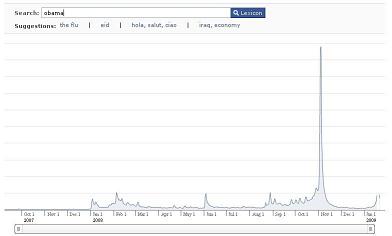
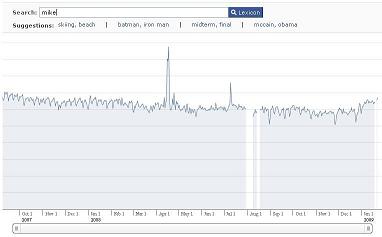
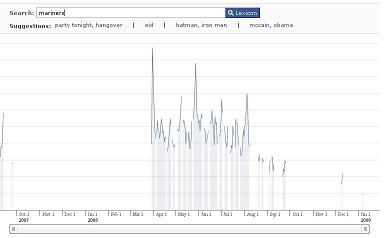
Lexicon. Facebook has a neat little app that "counts occurrences of words and phrases on Walls over time." (Must have a Facebook account to use, of course.) Here are a few of examples that I found interesting (click to see larger images):

Search term: "Obama" (note spike, which is in November):


Search term: "Mike" (note extremely even distribution -- hey, it's a popular name!)


Search term: "Mariners" (note that the range is essentially baseball season. The uber-observant might note that the graph falls off before the World Series, haha.)
[via Daugher Sabrina]


[1] I notice -- and even mock -- spelling and punctuation errors, but I can assure you that I don't refer to people who commit these mistakes as "infidels" who commit "acts of terror," sheesh. Relax, people.

[categories]   , , [tags] tools, pizza cutter, dogfooding, Facebook, spelling, punctuation

[2] |


  11:20 AM

You know what I wouldn't mind? A bit of sunshine. Wrong time (winter) in the wrong place (Seattle), I guess.

Fake reviews prompt Belkin apology. I guess I've just always assumed that some number of product reviews (and restaurant reviews) are by shills. (I'm usually most suspicious of the ones with the really, really bad grammar, haha.)

The #1 Song on this Date in History. What was the #1 song on the Billboard chart on the day that you were born? (Me, it was Elvis Presley, "Too Much.") [via Sarah] [18 Feb 2012: h/t to Rupert Charles for the updated link!]

What the Web knows about you. Check out the list in the sidebar of all the things the author was able to find about himself. [via ... just about everyone]

Facebook and list mania, aka "25 Things About Editors". John McIntyre's editor-specific take on the "25 things about me" meme that's been going around.

[categories]   , , , , [tags] product reviews, Billboard, privacy, Facebook

[2] |


  02:55 PM

Today we concentrate on people's opinions, I guess. Except for that teeth thing.

Grammar Girl's Strunk & Twite: An Unofficial Twitter Style Guide. Grammar Girl posts thoughts (more like commandments) on how to write tweets. [via Fritinancy]

Chew on this: We'll soon be able to grow replacement teeth. "Now comes tooth regeneration: growing teeth in adults, on demand, to replace missing ones. Soon." Finally, a good use for wisdom teeth.

The Secret saved my life! If you've ever wondered about all the hype around the book/CD/DVD The Secret and its claim to be able to improve your life just through the power of thinking, you might find this book review quite inspiring! [via (again) Fritinancy]

And speaking of Amazon reviews, have a look at the customer reviews for the Playmobil Security Check Point.


[via Friend Megan]

How to Give Directions. I take a professional interest in how people write up recipes and in how they give directions. Both can be harder than they appear. This, another entry in the eHow wiki, is excellent advice for the second of these challenges.

[categories]   , , , [tags] twitter, teeth, The Secret, Playmobil, directions

|


  07:02 PM

What kind of person uses a computer to generate their cover letter? At night?

4 Types of Person (a guide to stupidity) Odds are that you're not a Mr. Spock.

The Sky in Motion. Beautiful time-lapse movies of the night sky. [via Friend Steve]

Resolution Randomizer. Let the computer make your resolutions. The text is ok, but the graphics are great. (Requires Silverlight.) [via Brad Abrams]

Cover Letters from Hell. Killian & Company posts excerpts from some of the worst cover letters they've gotten. They observe: "An error-free letter is now so freakin' rare that the minimal care required to send a letter with zero defects, combined with a few crisply written simple declarative sentences, will, alone, guarantee a respectful reading of a résumé." [via Fritinancy]

[categories]   , , , [tags] astronomy, cover letters, new year resolutions

[2] |


  02:31 PM

If it's the end of the year, it must be time for end-of-the-year stuff.

The Seven Best Capers of 2008. A roundup (hey, wait ...) of criminal activity this year that showed unusual imagination. With the qualifier that the best capers of all are those that are never detected ...

Motorcycles Finally Go Green. "Motorcycles may deliver 70 mpg or more, but they can be 10 times more polluting per mile than passenger cars." And that's street bikes; traditional two-stroke engines -- still popular on dirt bikes for their power/weight ratios -- are incredibly dirty. (Advanced designs for two-stroke engines ameliorate this considerably.)

The Fargo campus responds to Redmond's December 2008 storm conditions. During our recent snow episode here in the Seattle area, the Microsoft campus was effectively shut down due to, you know, snow and cold. The folks at Microsoft's Fargo (North Dakota) campus were not impressed, and issued their own Real Estate and Facilities announcement.[1]

Saying it wrong on purpose. An article on wordplay via mispronouncinations (<-- haha). Much of the fun is contributed in the comments. (I particularly like refrigulation machine for the fridge.) [via wishydig]


[1] Virtually everyone who moves to Seattle from anywhere that regularly gets snow experiences their first few hours of a Seattle snowstorm and asks "What's the big deal? It's just snow!" Then they discover just how pathetically unprepared we are for weather like that.

[categories]   , , [tags] capers, lists, crimes, motorcycles, words, pronunciation

|


  12:02 PM

Sort of a holiday-catalog theme going on here.

A behemoth of a knife! The ultimate Swiss Army knife. They claim it's the complete list, but it does not appear to have, for example, a USB flash drive. That might be a different Swiss Army knife company, tho.

Dogs Understand Fairness, Get Jealous, Study Finds. They even get petulant: "The unrewarded dogs eventually stopped cooperating."

Bad Moon Rising. "Do you suffer from the heartache of Plumber's Butt?" DuluthTradingCompany.com has the solution for you.[1]


[via Friend Dennis]

Fortune this! What if Italian restaurants gave out fortune cookies? (Read the comments.) Sample: "Teach a man to fish and you feed him for a day. Send him to sleep with the fishes and he never needs to be fed again." [via Fritinancy]


[1] We are fans of this catalog, actually. I love that they have a section for "dog stuff."

[categories]   , , [tags] swiss army knife, plumber's butt, t-shirts, dogs, jealousy, fortune cookie

|


  01:33 PM

Getting toward gift-giving season. Let the crass ads begin ...

Jackson Pollock by Miltos Manetas, aka make your own Pollock. Just move the mouse around and click. [via Daughter Sabrina]

Microsoft's SideSight: Something Apple Should Watch. Taking the touch screen virtual, for (e.g.) devices that don't have enough actual screen space.

Hamlet (Facebook News Feed Edition). Sample: "Hamlet and the queen are no longer friends." The original is on McSweeney's; Angela Liao has created an image of what the Facebook page would look like:


[via Son Zack]

My First Rifle. Crickett .22 rifles. Perhaps your young one wants the Model 221 in pink.[1] It's probably a pretty good idea for the company to add the tag line "Not a toy." (This ain't no Red Ryder carbine-action range model air rifle, kid[2].)

[via Colleague David]


[1] For the record, I have no issue with (responsible) gun ownership. I learned to shoot a .22 as a youngster (one much like the Crickett); my instruction included an NRA safety course which, I have to say, was quite good. It taught, and I retain 40+ years later, a healthy respect for the dangers of carelessly handled firearms.

[2] If you have never read Jean Shepherd, you must. He is (was) the Garrison Keillor of Indiana, a decade earlier.

[categories]   , , , [tags] jackson pollock, art, painting, rifle, .22, hamlet, facebook, shakespeare, NRA, Jean Shepherd

|